
Ranking
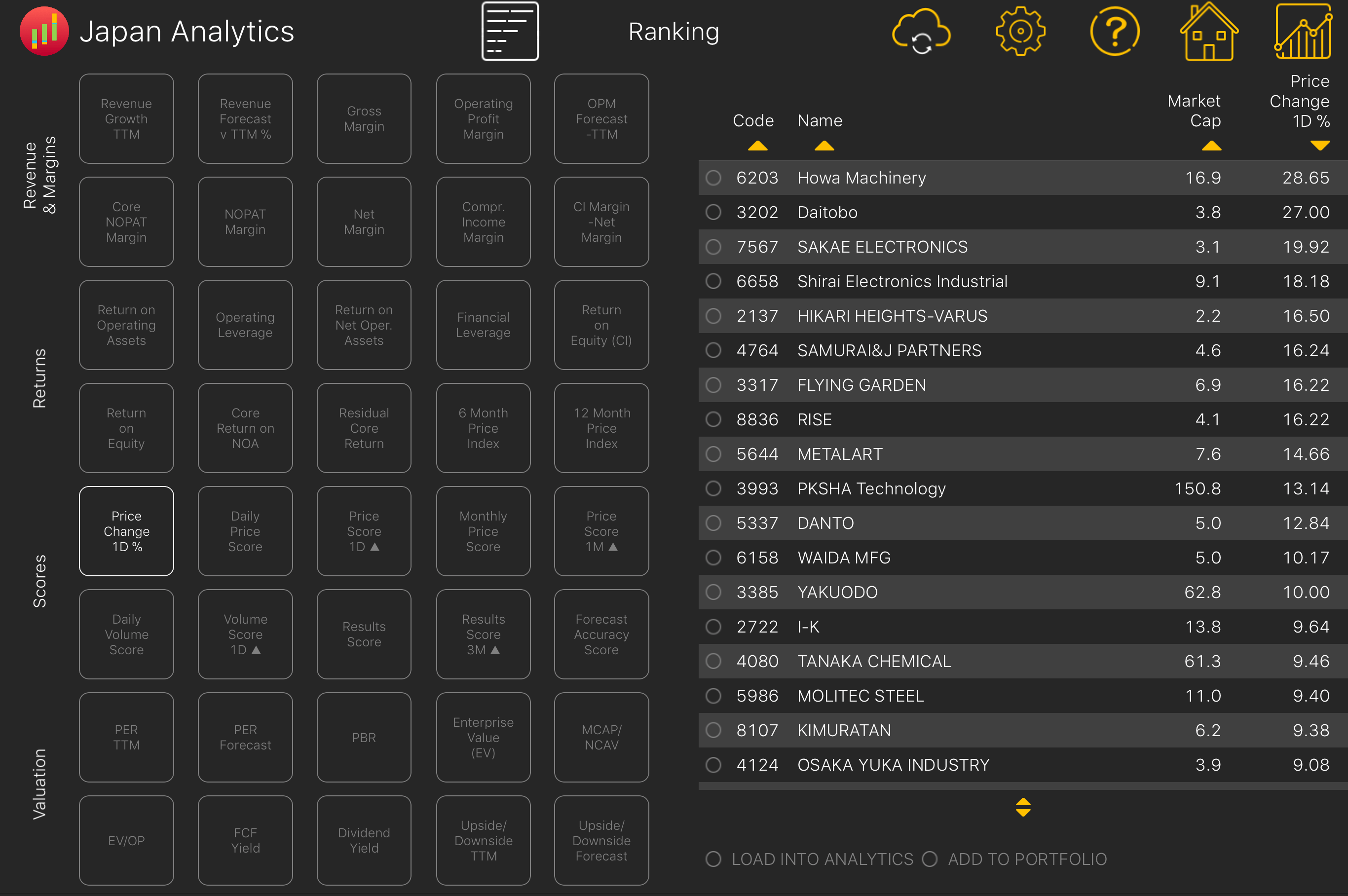
Ranking Module
The Japan Analytics Ranking Module ranks the universe of listed companies by 40 key factors including margins, returns, Japan Analytics Scores and valuation. The module defaults to open on Price Change 1D%. Results are displayed initially in descending order for the factor selected together with the stock code, company name and current market capitalization. Wherever possible the factors use data from the trailing twelve months (TTM). Null values and, in some cases such as PER or EV/OP, negative values are not displayed.
Factors are arranged in 4 groups, Revenue & Margins, Returns, Scores and Valuation.
Revenues & Margins

Revenue Growth TTM - The percentage change in Revenue/Ordinary Income for the most recent twelve months compared with the same twelve-month period one year before.
Revenue Forecast v TTM% - The percentage difference between the most recent forecast of Revenue/Ordinary Income for the current year and the realized Revenue for the most recent twelve-month period.
Gross Margin - For Non-Financial companies, Gross Profit (Revenue less Cost of Goods Sold) divided by Revenue for the most recent twelve-month period expressed as a percentage.
Operating Profit Margin - Operating Income/Ordinary Profit divided by Revenue/Ordinary Income for the most recent twelve-month period expressed as a percentage.
OPM Forecast - TTM - The percentage point difference between the most recent forecast of OP Margin and the realized OP Margin for the most recent twelve-month period.
Core NOPAT Margin - For Non-Financial companies, Core Operating Income After Tax divided by Revenue for the most recent twelve-month period expressed as a percentage.
NOPAT Margin - For Non-Financial companies, Net Operating Income After Tax divided by Revenue for the most recent twelve-month period expressed as a percentage.
Net Margin - Net Income divided by Revenue/Ordinary Income for the most recent twelve-month period expressed as a percentage.
Compr. Income Margin - Comprehensive Income to Common Equity divided by Revenue/Ordinary Income for the most recent twelve-month period expressed as a percentage.
CI Margin – Net Margin - Comprehensive Income Margin minus Net Margin.
Returns

Return on Operating Assets - For Non-Financial companies, Return on Operating Assets is Net Operating Income After Tax (adjusted for Operating Leverage) for the trailing twelve-month period divided by Average Operating Assets for the period expressed as a percentage.
Operating Leverage - For Non-Financial companies, the Operating Leverage Effect is Operating Liability Leverage (Average Operating Liabilities divided by Average Net Operating Assets) multiplied by the spread between the Return on Operating Assets and the cost of borrowing. The effect can be favorable (where the spread is positive) or unfavorable (where the spread is negative).
Return on Net Oper. Assets - For Non-Financial companies, Return on Net Operating Assets is Net Operating Income After Tax divided by Average Net Operating Assets for the most recent twelve-month period expressed as a percentage. It is also the sum of Return on Operating Assets and the Operating Leverage Effect. Return on Net Operating Assets is unaffected by Financial Leverage.
Financial Leverage - For Non-Financial companies, the Financial Leverage Effect is Leverage (Net Financial Liabilities divided by Net Assets) multiplied by the spread between the Return on Net Operating Assets and the cost of borrowing. A positive Financial Spread produces a positive Financial Leverage Effect while a negative Spread will result in a negative Financial Leverage Effect. If a company has Net Financial Assets, there will usually be net financial income and effect will be negative. A positive Financial Spread has a negative Financial Leverage Effect reducing Return on Equity and a negative Financial Spread has a positive Financial Leverage Effect increasing Return on Equity.
Return on Equity (CI) - Comprehensive Income Return to Common Equity is the sum of Return on Net Operating Assets and the Financial Leverage Effect after allowing for the effect of minority interests, Warrants, Preference Shares and Adjustments. Companies with negative Net Assets have been excluded. For companies reporting on a parent company basis only Net Income after valuation and translation adjustments is used in place of Comprehensive Income to Common Equity.
Return on Equity - Return on Equity is Net Income for the most recent twelve-month period divided by Average Shareholder’s Equity for the period. RoE is impacted by financial leverage and includes income from both operating and non-operating activities. Companies with negative Net Assets have been excluded.
Core Return on NOA - For Non-Financial companies, the Core Return on Net Operating Assets is Core Operating Income After Tax for the most recent twelve-month period divided by Average Net Operating Assets for the period.
Residual Core Return - For Non-Financial companies, the Residual Return on Net Operating Assets is Core Operating Income After Tax and Minorites less a 6% charge on Average Net Operating Assets for the most recent twelve-month period divided by Average Net Operating Assets.
6M Price Index - The percentage change in stock price from six months ago, excluding the most recent month. This can be used as an intermediate term indicator of price momentum.
12M Price Index - The percentage change in stock price from one year ago, excluding the most recent month. This can be used as an intermediate term indicator of price momentum.
Scores

Price Change 1D % - The change in stock price on the previous trading day.
Daily Price Score - A measure of the deviation of the stock price relative to the market index compared to its mean absolute deviation over the last one year of trading. Values of over 4.0 and under -2.0 are in the top and bottom percentile of observations and can be considered ‘Overbought’ and ‘Oversold’, respectively.
Price Score 1D ▲ - The one-day change in the Daily Price Score.
Monthly Price Score - A measure of the deviation of the stock price relative to the market index compared to its mean absolute deviation since listing. Values of over 4.0 and under -2.0 are in the top and bottom percentile of observations and can be considered ‘Overbought’ and ‘Oversold’, respectively.
Price Score 1M ▲ - The one-month change in the Monthly Price Score.
Daily Volume Score - A measure of the deviation of volume divided by shares outstanding compared to its mean absolute deviation over the last one year of trading. A value of over 6.0 (3.0 for large caps) is in the top percentile of observations and can be considered ‘Overtraded.’
Volume Score 1D ▲- The one-day change in the Volume Score.
Results Score - A measure of earnings and earnings momentum which covers the last eight quarters of revenue and operating income. The score has a maximum of 30 and minimum of -30. Where there is insufficient data the score will be 0.
Results Score 3M ▲ - The change in the Results Score over the last 3 months.
Forecast Accuracy Score - A measure of the accuracy of the company’s forecasts for Revenue/Ordinary Income and Operating Income/Ordinary Profit made since 2008 with 100 being a perfect score. Companies that have made fewer than five forecasts or have made forecasts on an inconsistent basis have been excluded.
Valuation

PER TTM - The trailing twelve-month Price/Earnings ratio is the current Market Capitalization divided by Net Income for the most recent twelve-month period.
PER Forecast - The Price/Earnings ratio forecast is the current Market Capitalization divided by the most recent company forecasts for Net Income for the current fiscal year. Forecasts for periods of less than twelve months are annualized.
PBR - The Price/Book ratio is the current Market Capitalization divided by Shareholder’s Equity for the most recent quarter.
Enterprise Value (EV) - For Non-Financial companies, the Enterprise Value is the current Market Capitalization plus Net Financial Assets, Minority Interests, Preferred Shares and Warrants as of the most recent quarter. Enterprise Value is a more accurate representation of a company’s value as it includes all the claims on the business.
MCAP/NCAV - For Non-Financial Companies, Market Capitalization divided by Current Assets less Total Liabilities (Net Current Asset Value). This is where to find so-called "Net-Nets".
EV/OP - For Non-Financial companies, Enterprise Value divided by Operating Income where both EV and OP are positive.
FCF Yield - For Non-Financial companies, Free Cash Flow for the most recent twelve-month period divided by Market Capitalization expressed as a percentage where FCF and EV are positive.
Dividend Yield - Cash flow Dividends Paid in the most recent twelve month-period divided by current Market Capitalization and expressed as a percentage.
Upside/Downside TTM - The percentage upside or downside to a No-Growth Valuation assuming that the most recent twelve-month period’s residual income is sustainable.
Upside/Downside Forecast - The percentage upside or downside to a No-Growth Valuation based on the company’s current forecast for Operating Income/Ordinary Profit.